I Lost Money When the Iran War Started. So I Built This.
I remember the colour more than the numbers. The war over the Strait of Hormuz started on Saturday, 28 February 2026. On the Monday, at home in Des Moines, I opened my brokerage app and the whole screen was red. I knew every company I owned by name, and I could not have told you why all of them were falling together.
I want to tell you how I got there, because I think a lot of people are standing where I stood.
Numbers made sense to me
I grew up in Togo, in West Africa, and came to the United States in 2012. At school, maths was the one subject that never felt like guessing. You did the work and the answer came out right or wrong, and you could see why. When I discovered the stock market, I assumed it would be the same. If I was good with numbers, surely I could get good at reading companies.
I wanted to be an analyst. What I noticed quite quickly was that the people who seemed to read the market best weren't always the cleverest people in the room. They had better tools. They paid thousands of dollars a year for software and research that showed them what was underneath the headlines. I had my phone, my brokerage app and the news.
How I actually built my portfolio
I'd love to say I had a plan. I didn't. I bought one name at a time. Someone mentioned a company, or I read about it, or it turned up on a list of stocks to watch, and I bought a little. Ford. NIO. Tesla. An air-taxi company. A small software company. A telephone company. By the time the war started I owned 17 different stocks, and in my head that meant I was well spread out.
I only learned otherwise later, when I put those names into the tool I was building. One of the first things it showed me was that Ford, NIO and Tesla were all car makers. I had never thought of them as the same bet, but to an oil shock they are. Fuel prices, shoppers with less to spend, supply chains: the same things reach all three. Seventeen names did not mean seventeen different risks. Some of them were the same risk wearing a different logo.
February to April
The war ran from 28 February to the ceasefire on 8 April. Brent crude went from about $71 a barrel to a daily peak of about $138. I watched it happen the way most people did, through headlines and a lot of red.
I held most of what I owned. I sold a few things, and some of those sales turned out well. I'd like to call that judgement, but honestly I didn't know what I was holding, so I couldn't tell a good decision from a lucky one. When it was over, I had lost money.
The money hurt less than the feeling that I'd been guessing the whole time.
What I wish someone had shown me
A few things became obvious to me only afterwards.
On an ordinary day, most of what a single share does comes down to its own company. On a day like the one the war started, that changes. Much more of the move comes from the whole market and from the industry the company sits in, so shares in the same industry tend to fall together. If I had known which industry each of my holdings sat in, I would have known what kind of news could reach them, and that one kind of news could reach several of them at once.
A big down day feels like a warning, and sometimes it is one. But when we later went back through years of daily prices for the platform's Shock Desk, really big days turned out to come only two or three times in every hundred. Something that rare feels meaningful. Sometimes it is just rare. I panicked on some of those days and ignored others, and I had no record of what usually came after a fall like that.
I also mixed up two different games. I said I was investing for the long run, then I'd buy and sell within weeks because of something I'd read. That's trading, and I was doing it without being able to see what was coming.
And I never separated what my stocks did from what the whole market did. When everything falls, your own picks look worse than they are. When everything rises, they look better.
So I built the thing I needed
I started building DELAX GEO-RISK in March, while the war was still going. I didn't need more tips. I'd had plenty of tips. What I needed was to see the risk sitting in my own account, in plain words, before I made the next decision.
That's what DELAX GEO-RISK is. It tries to answer three questions in under a minute. What's happening? Why does it matter to me? What should I watch next?
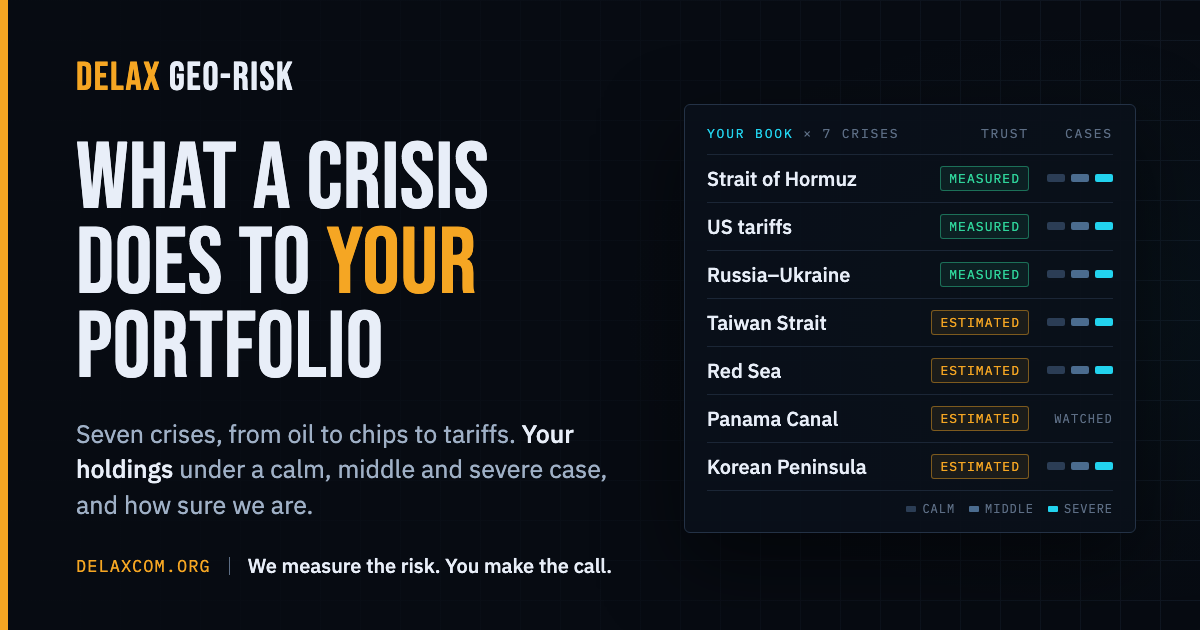
The Iran war is just where my story starts. The platform follows several crises side by side, from shipping chokepoints to trade wars to conflicts that have never happened yet. You put in what you own, and it shows how each crisis would reach your book, case by case, from the calm outcome to the severe one. It shows the odds beside each case, and it never adds the crises together into one scary number.
Every figure carries a label that says how sure we are. Some crises are fitted to how markets really moved when something like them happened. For others there is no market move to fit: either the event has never happened, or it did happen and share prices never tracked it. Their figures are reasoned estimates, and they are marked that way. When a holding isn't covered, the platform says so rather than inventing a number. That mattered to me more than almost anything else. I'd been burned by sources that sounded certain about everything.
DELAX won't tell you what to buy or sell, and that's deliberate. I've taken enough tips to know a tip is only as good as the person giving it. What I can give you is the view I couldn't afford back then: what your book is exposed to, by how much, and how sure we are about it.
If you own shares
You don't need to know which crisis comes next to know which ones would reach you. Put your own holdings into the Workspace and look at them under each crisis the platform follows. It takes about a minute, and it's free.
I built it for the person who opened that app on 2 March and had no idea what was happening to their money.
We measure the risk. You make the call.