The Quietest Exposure: Why Nepal Is the Most Affected Economy Nobody Is Charting
Komla Gatho | DELAX GEO-RISK | August 25, 2026
I keep a list of countries I check when a chokepoint closes. Nepal is not on most people's list. After the last six months, it is near the top of mine.
Every risk desk on the planet is watching the same map right now. Tanker traffic at Bandar Abbas. War risk premiums in the Gulf of Oman. Brent hovering near $90 after touching $110 in May. Qatari cargoes that load at Ras Laffan and never arrive.
The countries in those headlines are the obvious ones. Iran, Israel, the Gulf producers, China as the buyer of last resort, Japan and Korea as the ratepayers. I have nothing new to tell you about any of them, because a hundred desks are already there.
Nepal is in none of those headlines. It has no coastline, no refinery, no tanker fleet, no energy contract with any Gulf producer, and no seat at any negotiation over the Strait of Hormuz.
I think it may also be the most structurally exposed economy on earth to what happens in that waterway.
The exposure nobody prices
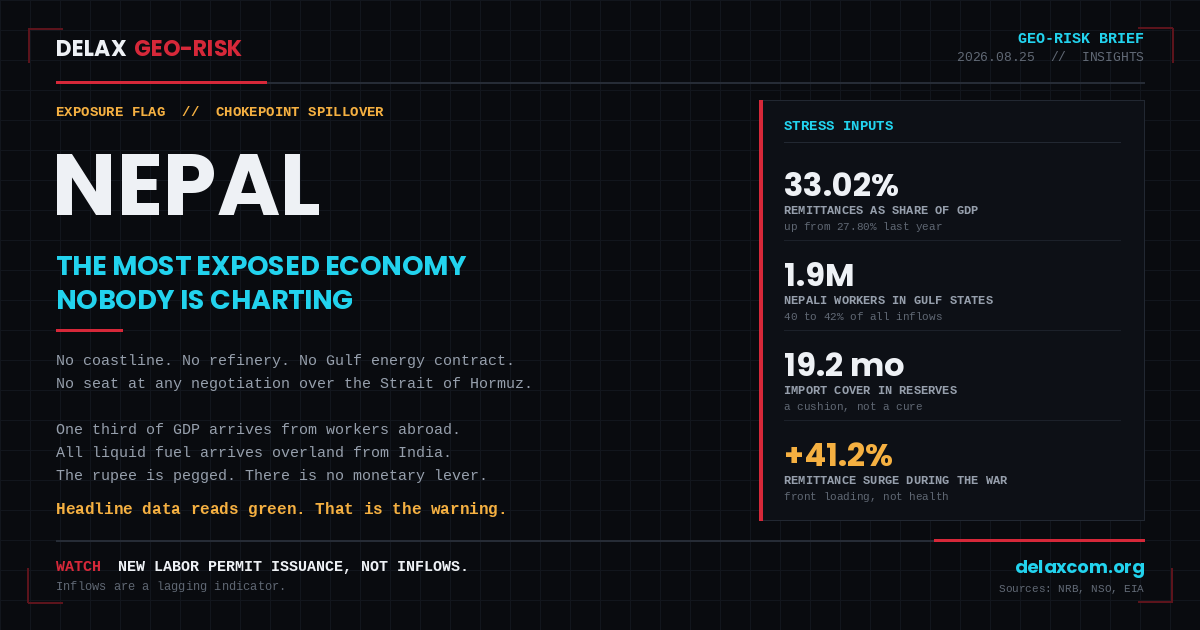
I start with the number that defines the country. Remittances are projected to equal 33.02 percent of Nepal's gross domestic product this fiscal year, up from 27.80 percent the year before, according to the National Statistics Office. In an economy of under $50 billion, that means roughly one rupee in three circulating through Nepali households arrives from someone working abroad.
Then I look at where those people are. Nepal Rastra Bank calculates that 40 to 42 percent of all remittance inflows originate in the Gulf. Roughly 1.9 million Nepali workers are spread across the UAE, Saudi Arabia, Qatar, Kuwait and Bahrain, with the UAE alone hosting about 478,000. In fiscal year 2024/25 the country issued 839,266 labor permits, and Middle Eastern destinations absorbed roughly 80 percent of them.
Then fuel. Nepal imports every liter of its liquid fuel: petrol, diesel, aviation fuel, and the LPG cylinders that cook most of the country's food. All of it arrives overland from India, priced by Indian Oil Corporation, which sources heavily from the same Gulf that is currently blockaded. Nepal spends foreign exchange on a barrel it never touches and cannot substitute.
And then the part I find hardest to look away from. The Nepali rupee is pegged to the Indian rupee. When the dollar strengthens against the INR, Nepal imports that move mechanically, with no independent monetary lever to soften it. In March the dollar hit a record Rs 147.15 in Kathmandu, and the central bank attributed the move to geopolitical tension and the fixed rate with India.
Three channels. Energy, labor, currency. All three run through one strait, and none of them are Nepal's to negotiate.
What already happened
I am not describing a hypothetical. The exposure has already been tested once, and I watched it happen in close to real time.
When the campaign against Iran began on February 28, the transmission was immediate. Airspace disruption stranded travelers at Tribhuvan International Airport within days. More than 86,000 Nepalis registered for emergency assistance. On March 1, the Ministry of Labour halted issuance of labor permits to nearly a dozen West Asian destinations, switching off the migration pipeline overnight.
The cost side moved just as fast. Petrol in Kathmandu reached Rs 172 per liter. The Nepal Freight Forwarders Association reported that freight charges tripled and warned that prices in some goods categories could rise as much as 50 percent. A UNDP assessment published in mid April flagged Nepal among the countries facing the highest risk of cumulative human development losses across Asia and the Pacific if the conflict persisted.
Kathmandu resumed Gulf labor approvals in late April, after roughly six weeks, under pressure from a job market that cannot absorb its own young people. The permits came back. Nothing about the underlying exposure went anywhere.
The part that made me stop
Here is where my own read gets uncomfortable, and where I expect most dashboards to tell you Nepal is fine.
The headline macro data right now looks excellent. Nepal Rastra Bank's report covering the ten months to mid May 2026 showed remittance inflows up 41.2 percent to Rs 1,916.90 billion. Foreign exchange reserves reached Rs 3,704.55 billion, equal to 19.2 months of import cover. The current account and the balance of payments both ran surpluses. Inflation sat at 5.04 percent.
So: a remittance economy, in the middle of a Gulf war, posting a 41 percent surge in remittances and record reserves. On any conventional stress index, Nepal scores green. Mine included, if I only fed it those series.
I read it the other way. A surge that large, arriving in exactly the quarter when the labor pipeline was frozen and workers were registering for emergency evacuation, does not look to me like a labor market in good health. It looks like front loading. Workers moving savings home ahead of perceived danger. Informal hundi channels shifting into formal banking under disruption. Returnees repatriating balances rather than remitting income. Crisis inflows and growth inflows look identical in a monthly bulletin. They diverge violently about two to four quarters later.
I want to be fair to the buffer, because it is real. Nineteen months of import cover buys Kathmandu time that Colombo did not have in 2022. But import cover is a cushion, not a cure, and it is being asked to absorb something that is not a spike. The US Energy Information Administration does not expect Middle East production near pre conflict levels until early 2027, and projects Brent to average around $87 for 2026. That is not a shock Nepal waits out. It is a new baseline Nepal has to live inside.
The indicator I think most people are watching is the wrong one
If I am tracking Nepal, remittance inflows tell me almost nothing useful. They are a lagging indicator. By the time they fall, the damage is eighteen months old.
These are the five I actually watch.
Monthly labor permit issuance by destination. New permits, not renewals. New permits are the forward book of the remittance economy. Renewals are the back book. A renewal heavy month with thin new issuance tells me the pipeline is drying while the receipts still look fine.
Gulf construction and services hiring. Higher oil revenue can support Gulf employment in the short run, which is why I think the first order read on this is usually wrong. The second order read is the one that matters. Sustained disruption slows project execution, and construction is where the majority of Nepali labor sits.
LPG and diesel pass through into the Kathmandu basket. Fuel enters Nepali inflation twice, once directly and once through transport costs into food. When food inflation runs ahead of headline inflation, I take that as the tell that the pass through is complete.
Return flow volume. Not stranded worker counts during an acute event, but sustained monthly returns without matching departures. That is the shape of a structural loss rather than a cyclical one.
Aviation routing. Nepal's inbound tourism runs largely through Gulf transit hubs, and the United States is its third largest source market. Route suspensions and fuel driven fare increases hit the one foreign exchange earner that is not remittances.
What I take from it
The countries hurt worst by a chokepoint event are frequently not the ones on the chokepoint. They are the ones three steps downstream, with no substitution capacity, no monetary independence, and no standing at the table where the corridor gets reopened.
Nepal fits that profile more cleanly than almost any state I track. It has no direct relationship with the conflict, no direct exposure to the commodity, and near total dependence on both. Its current data is strong, and its current data is backward looking. Both things are true at once, and I think the second one is the important one.
For anyone carrying Nepal exposure, the risk I would flag is not that the numbers turn. It is that they stay good for another two quarters and then turn all at once, because the mechanism that produced the good numbers is the same mechanism quietly eroding the base underneath them.
The Strait of Hormuz is 21 miles wide at its narrowest point. Kathmandu sits 2,300 miles away and cannot see it. I do not think that distance is protective. I think it only makes the exposure invisible.
KOMLA GATHO DELAX GEO-RISK
DELAX GEO-RISK tracks stress indexing across 60 plus countries, tied to energy benchmarks, metals, sovereign yields and trade corridor data. Full dashboard at delaxcom.org.
- Sources: Nepal Rastra Bank, National Statistics Office of Nepal, Department of Foreign Employment, US Energy Information Administration, UNDP, Kathmandu Post, The Diplomat, Al Jazeera, Reuters.